
Today, the Canadian government issued a sudden announcement, declaring an additional 25% tariff on a series of imported goods, covering multiple categories including steel, aluminum products, and certain steel derivatives. The policy takes effect immediately, with no transition period, instantly causing a shock in the global trade market. This tariff increase is not an isolated action but a continuation of Canada’s recent trade policy adjustments, underpinned by complex political and economic considerations, with its impact rapidly extending to China-Canada trade and the global supply chain.
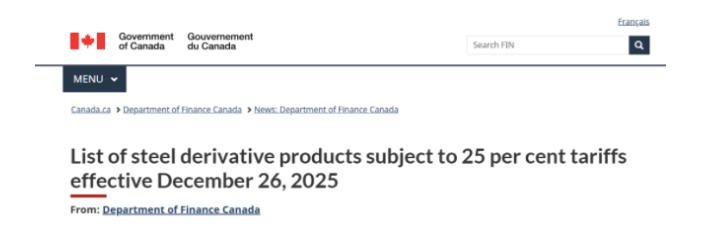
It is reported that the core scope of this tariff increase targets steel and aluminum products containing Chinese smelting and casting components, even including goods re-exported from third countries containing only a small proportion of Chinese steel components. Canadian customs clearly requires importers to provide complete smelting and casting source documentation for each batch of steel. Once it is verified that the goods contain relevant Chinese components, regardless of the final export country, an additional 25% tariff must be paid. At the same time, Canada has also tightened quota restrictions. The import volume of steel and aluminum from non-free trade agreement partners (including China) is reduced to half of 2024 levels, and any excess will be subject to an additional 50% tariff. This dual restriction effectively cuts off the main channel for Chinese steel enterprises to enter the Canadian market.
Tracing the roots of this tariff escalation, it is actually a product of intertwined domestic and international difficulties for Canada. On one hand, Canada has long relied on the U.S. market. Since 2025, the Trump administration continued to impose additional tariffs on Canada, causing heavy economic losses, with tariff disputes alone resulting in a domestic GDP loss of about 1.8%, equivalent to 50 billion Canadian dollars. To alleviate pressure from the U.S., the Canadian government led by Karni chose to follow the U.S. and use China as a "scapegoat," attempting to seek U.S. tariff exemptions in exchange for targeting China. On the other hand, Canada’s domestic manufacturing sector is facing difficulties, with notable employment pressures in industries such as steel. The government hopes to protect domestic industries by raising tariffs, appease domestic unions, and boost approval ratings.
This tariff increase has caused significant impact on both China and Canada. For China, although its share of steel and aluminum exports to Canada is not the largest, the tariff barrier directly hinders the relevant Chinese enterprises’ exports. Some companies long-established in the Canadian market face the dilemma of being forced to withdraw, and Chinese companies like Hikvision have already faced unreasonable suppression by the Canadian government, making this tariff escalation undoubtedly a further blow. Meanwhile, China has taken reciprocal countermeasures, previously imposing tariffs on Canadian rapeseed, peas, pork, and other products, severely damaging Canadian agricultural exports, with the rapeseed inventory in Saskatchewan once increasing by 40% year-on-year.
For Canada itself, the tariff increase is arguably “hurting others without helping itself.” Canadian domestic manufacturers have to face rising costs of imported raw materials and significantly increased compliance costs, which will ultimately be passed on to consumers, driving up domestic prices. What is even more noteworthy is that Canada’s differential treatment has sparked controversy—steel and aluminum products containing Chinese smelting and casting components that are processed in the U.S. and exported to Canada are exempt from tariffs. This double standard not only violates the principle of fair trade but also undermines its stated purpose of "protecting domestic industries."